


Biostimulants show promise in post-mancozeb blight control
News - 12.05.26
Biostimulants and phosphonates show promise in post-mancozeb blight strategies
The loss of mancozeb has left a significant gap in blight programmes, both for late blight and Alternaria control, as well as resistance management. Trials by The Potato Partnership have been looking at how biological and plant health products could help support future strategies.
Rather than simply adding more of the same systemic chemistry, The Potato Partnership (TPP) has been examining a range of biologicals, plant health stimulators and phosphonate-based products as part of a more integrated approach to disease control.
“We are seeing a lot of potassium phosphonate-based products coming through, so there is a lot of focus on these,” says Don Pendergrast, Technical Manager for Non-Combinable Crops at Agrii.
“We also looked at some novel biocontrol options alongside plant health stimulators like Innocul8, which we have looked at for some years now.”
Building on earlier blight trial work
The 2025 trial was carried out at the Eurofins site in Derbyshire using the variety Melody, inoculated with EU36 and EU37. However, conditions were so dry that little blight was seen until September, by which time the dominant strain was the oxathiapiprolin-resistant EU46.
The work built on 2024 trials, where the biostimulant Innocul8 was used at the beginning of the programme. Alongside fungicides, it appeared to show a possible route for managing the loss of mancozeb, Don explains.
“Last year’s trials built on our 2024 work, which used the biostimulant Innocul8 at the beginning of the programme. Alongside fungicides, it seemed to indicate a way of managing the loss of mancozeb.”
In the 2024 work, the conventional systemic fungicide programme, with Innocul8 replacing mancozeb, outperformed the programme including mancozeb in terms of green leaf area and late blight infection levels by the end of the season.
“The plant health effects of Innocul8 were underpinning the fungicide programme,” says Don.
Alternative products tested in 2025
Because of these results, and with mancozeb no longer on the market, all 2025 programmes tested were based on a programme using early Innocul8 alongside the standard fungicide programme.
This included several new products close to launch, submitted by crop protection manufacturers. Don says the aim was to move away from mancozeb always being in the conversation and to compare a series of alternative products representing a different approach.
Mixed into this programme, TPP compared different treatments using a range of potassium phosphonate products, micronutrition, orange oil and plant extracts.
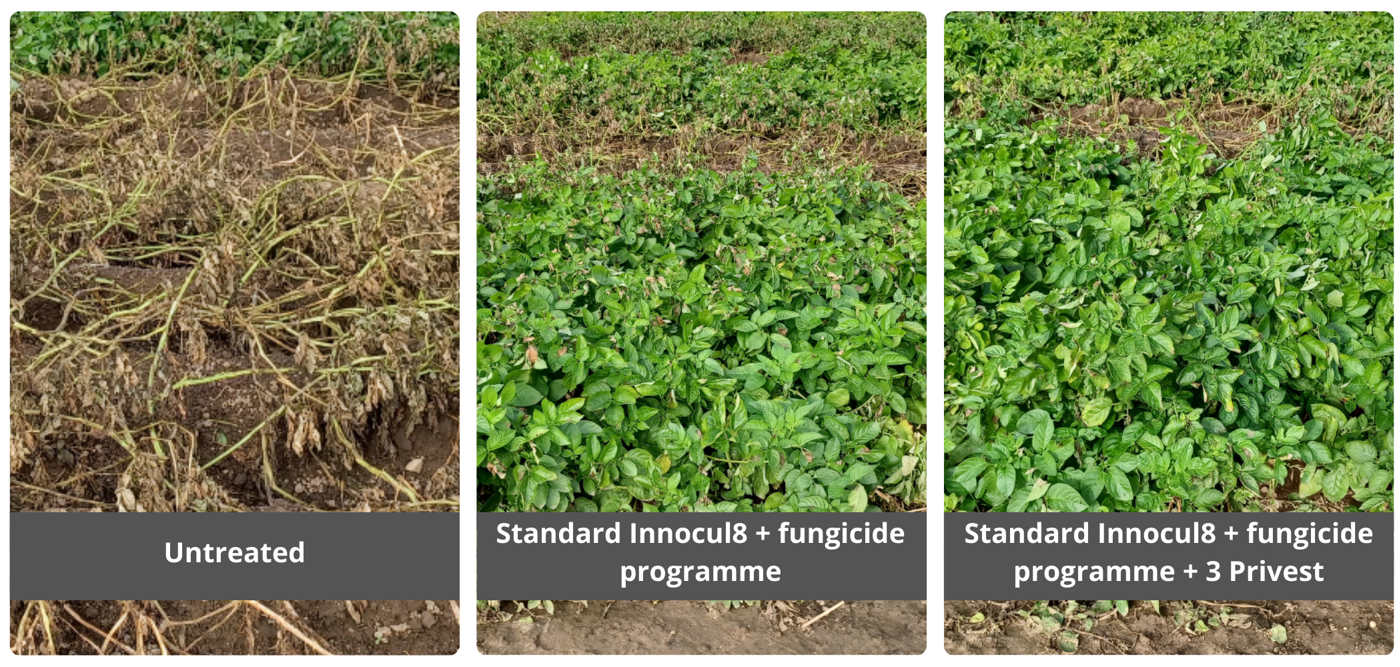
“The first major infection event happened on the 14th of August, and differences were clearly visible by the middle of September, just prior to crop desiccation.
“There was a clear benefit to adding a third application of potassium phosphonate in the programme. Three applications of Privest, which contains ametoctradin + potassium phosphonate, clearly looked like the best plot in the trial.
“This is partly because it was the only programme that excluded oxathiapiprolin or an equivalent mode of action fungicide, given that the dominant strain in the trial was OXTP-resistant EU46.”
Visible crop effects from orange oil and plant extracts
The orange oil treatment also looked noticeably different in the field, Don says.
“The leaves were more waxy, and they had a sheen to them, which is no surprise considering we were applying something oil-based.
“The plant extract produced a similar sheening, and the crop looked healthy throughout.”
Given the number of phosphonate products applied, residues were checked in the tubers at the end of the season. These were well below the maximum residue limit.
“We will continue to monitor this, because in a different season you may have to use up to six applications, which may take you close to the limit,” adds Don.
Last year’s work shows that there are alternative product options that can support a standard blight programme. Additional applications of potassium phosphonate products, orange oil products and micronutrition all offered benefits in the programme.
The aim of the 2026 TPP blight trials will be to determine the most suitable timing for these options.
Biologicals and blight resistance management
The confirmed presence of both resistant EU43 and EU46 strains in the UK, combined with the loss of the primary multisite in fungicide programmes, means growers are right to be concerned about blight fungicide resistance this season, says Don.
One question is whether some of the biological products tested by TPP can offer a degree of protection for systemic chemistry.
“We have to draw partly on experiences in other crops. But, if you think of mechanisms like eliciting the plant’s own defence mechanisms, which is what Innocul8 does, there is evidence that it disrupts resistant strains as well as susceptible ones.
“Products like orange oil have a physical mode of action, so they work similarly to a multisite.
“The more things you can add in a programme, the more potential you have to disrupt the overall flow of resistance development, particularly in high-pressure situations. However, biologicals are not the answer to blight resistance, especially when they act as biostimulants.”
Supporting Alternaria control after mancozeb
The loss of mancozeb will also affect Alternaria control, another issue the industry will need to manage in the coming years.
According to Ed Maule, Lead Potato Technical Advisor for Agrii, much of Alternaria control is about keeping the crop healthy throughout the growing period, with strong base nutrition supporting specific Alternaria fungicides in a preventative and protective programme.
“A lot of Alternaria control is about keeping the crop healthy throughout the growing period with good base nutrition to support specific Alternaria fungicides in a preventative, protective manner,” says Ed.
For this reason, the TPP trials also examined how plant health elicitors and micronutrition can enhance the efficacy of conventional fungicides against Alternaria.
“The trial showed that Innocul8 delayed the ingress of Alternaria into the trial. The best treatment was a fungicide programme supported by Innocul8 early, followed in later applications by a biostimulant containing copper and zinc.
“This supports green leaf area retention. We know there are some varieties that can lose a lot of green leaf area quite early. If we can take those through to later in the season with this approach, we can help it to achieve its yield potential.”
Developing more integrated blight strategies
The TPP trials suggest that future blight and Alternaria programmes are likely to rely on a more integrated approach, combining conventional fungicides with products that support plant health, resistance management and green leaf retention.
While biologicals and biostimulants are not a direct replacement for core fungicide chemistry, the latest work shows they may have a valuable role in supporting disease control programmes as the industry adapts to the loss of mancozeb.
Join Our Community

Agrii X
We love engaging with clients and partners. Give us a follow and let's share stories for the community.

Agrii Instagram
A picture paints a thousand words. Follow us on Instagram to see what we are up to.

Agrii Facebook
Follow us on the worlds biggest social media site for the latest news and events straight to your feed.

Agrii LinkedIn
If you are all about the business, connect with us on LinkedIn to build your network
Stay In Touch

Journal Sign-Up
Receive email updates on topical news and information from around Agrii and UK Farming.

Listen To Our Podcasts
Listen to the Tramlines Podcast. Fortnightly chat about agriculture and trials with your host Tony Smith.

Agrii Insights
Read essential agri intelligence for profitable farming.

Find an Event
Join us for our upcoming events and tours.