


Can the latest farm tech save on fungicide costs this spring?
News - 29.04.26
How can agri-tech help target fungicide spend without compromising yield?
Early disease protection or a more cautious start? With tighter margins and shifting disease pressure, many growers are reassessing fungicide strategy. Agrii Digital Technology Farm trials are exploring how new tools and better data can support more precise decisions.
Spring fungicide decisions often involve a balancing act. Protect crops early and thoroughly, or hold back and risk disease pressure building later.
This season the decision may feel sharper than usual. Commodity prices remain under pressure, while disease risks are evolving. Many varieties remain vulnerable to yellow rust, and earlier drilling dates increase the potential for septoria development.
The question for many growers is whether new technologies can help refine fungicide decisions. Better disease monitoring, improved data and targeted applications could potentially optimise spend without compromising yield.
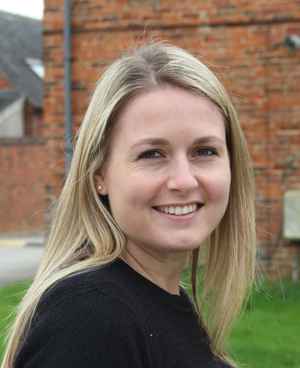
Lucy Cottingham
Testing technology through Digital Technology Farm trials
Agrii’s Digital Technology Farm programme is now in its third year. The trials bring together new monitoring tools, disease models, agronomic insight and on-farm comparisons to assess how technology can support decision-making.
Lucy Cottingham, Digital Agronomy Development Manager at Agrii, says the work compares a technology-led trial area with the host farmer’s standard programme.
“The variety that is sown gives us an understanding of what the disease pressure might be,” says Lucy.
“We utilised the Contour platform disease risk tool, which uses a traffic light system for disease risk of different wheat diseases at a given time.”
Using spore detection to track disease risk
The trials also included the use of BioScout, a smart spore trap designed to monitor airborne fungal disease pressure directly within the crop.
The device sits in the field and captures fungal spores carried by the wind. Inside the unit, spores are collected on sticky tape and analysed using a microscope and AI to automatically identify different disease spores.
“Combining the information from BioScout on what diseases were detected with the disease risk indication in Contour, added to us walking the crop to see what disease we could find, gave us the basis for building the fungicide programme,” adds Lucy.
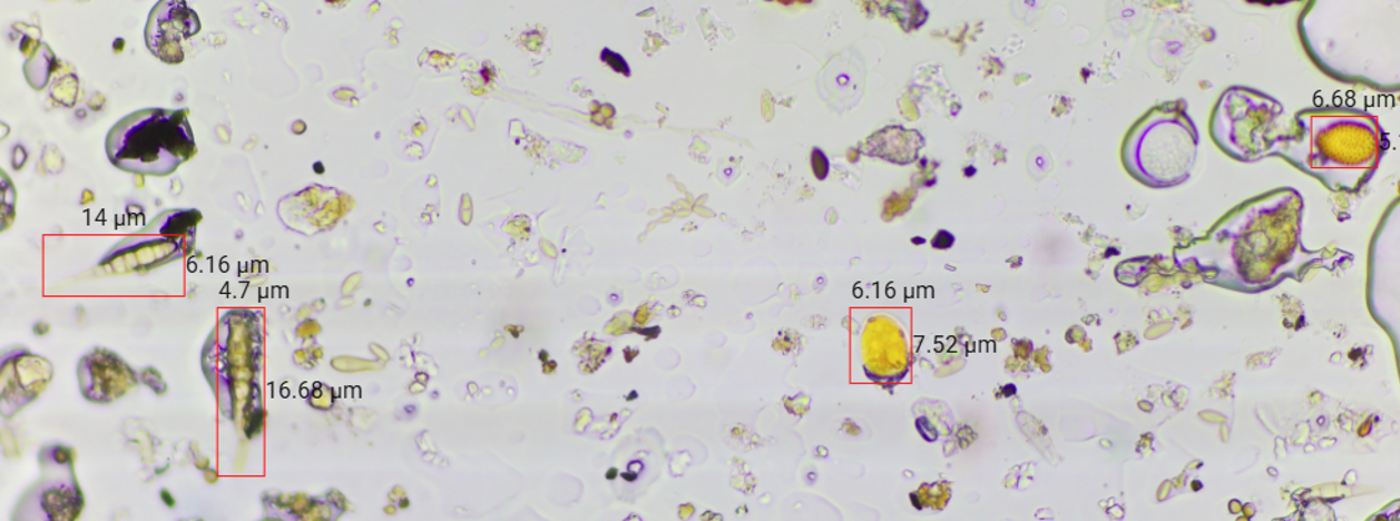
Bioscout
Adjusting fungicide strategy based on conditions
Last spring’s dry weather influenced the programme. Disease pressure remained lower than expected early in the season, allowing the team to reduce fungicide inputs at T0 and T1.
Instead, the early approach moved to a biostimulant and nutrition-led strategy, using the plant health elicitor Innocul8 alongside micronutrient mixes. These products were used to support plant health and resilience, rather than directly replacing fungicide activity.
As the season progressed, yellow rust became active in the crop. The programme then switched to a more typical SDHI and azole mix at T2, followed by a prothioconazole-tebuconazole mix at T3.
“One of the learnings from the dry season last year was that we didn’t necessarily get the benefit of pushing late green leaf area retention because the crop droughted out by the time you would expect to see the benefit,” says Lucy.
In other words, protecting late leaf layers does not always translate into yield if the crop runs out of moisture before grain fill completes.
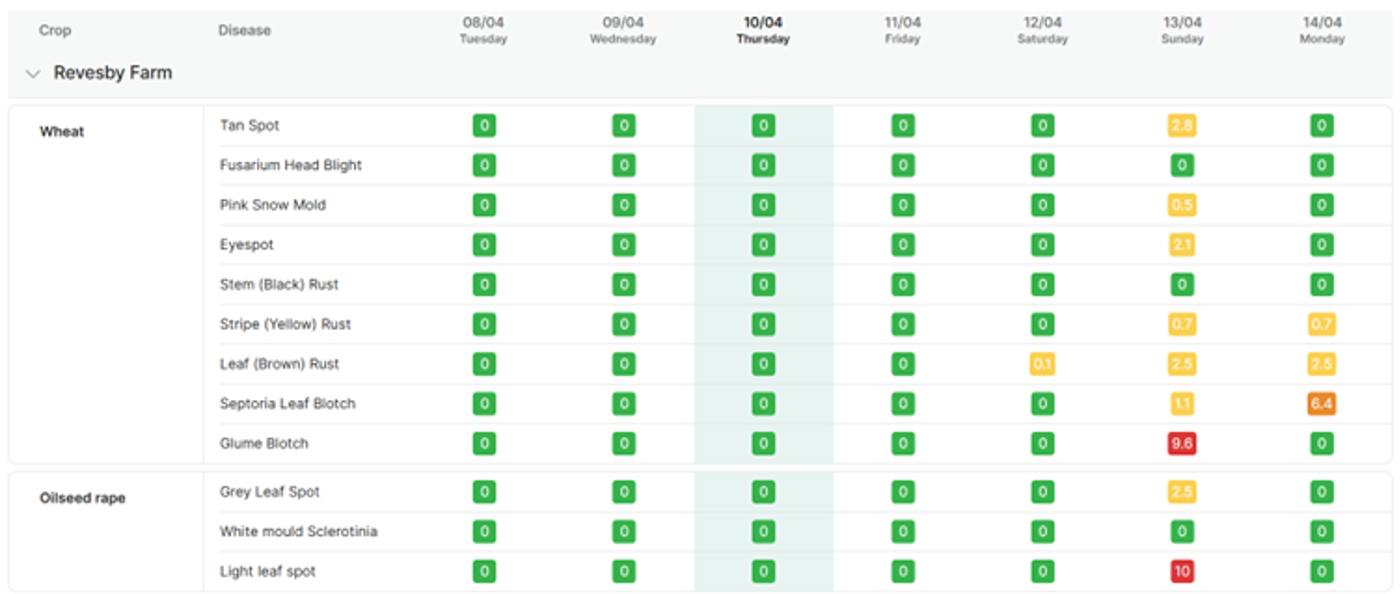
Disease Risk Forecasting in Contour
Yield response and overall programme cost
Across the season, the overall cost of the fungicide programme in the trial area was the same as the farm standard.
Lucy explains that, although less fungicide was used, some of the biostimulant and nutritional products applied offset the savings.
The key result was crop performance. The Digital Technology Farm trial area yielded 0.8t/ha more than the farm standard, which Lucy partly attributes to better crop health.
Micronutrient support, Innocul8’s stimulation of the plant’s hypersensitive response and a two-layered variable rate nitrogen strategy all contributed to improved performance.
Balancing technology with practical farm risk
Although the trial resulted in a positive response for the technology-led approach, Revesby Estate Farm Manager Peter Cartwright believes a more robust approach still has merit across varying seasons.
“We are applying nitrogen and fungicides, expecting the crop to stay green into grain fill, whereas the technology is reacting to what it is seeing,” says Peter.
“Last year, the hot days in June killed the crop off, and we didn’t get the yields we expected.
“I expect all the other technology will come, like the spore traps. But understanding what it’s telling you and how to use it is still in development.
“At the moment, I don’t want to risk my whole farm area because a piece of technology is telling us not to do anything because there’s no disease.”
Latent disease testing in 2026
For 2026, Agrii will also test OptiGene’s latest diagnostic tool, which is based on DNA amplification technology.
The product can provide a diagnostic test for the presence of disease in a crop leaf in 20 minutes. Lucy says the tests will be used to build a clearer picture of latent disease levels as fungicide choices are made within the technology trial.
She believes it could become a valuable tool for agronomists to keep in the car when assessing crops in the spring.

Optigene
Technology as part of the agronomy decision
The trials highlight an important point. Technology does not remove the need for agronomy decisions, but it can strengthen them.
Combining disease modelling, spore detection, latent disease testing and field observation helps refine timing and build a clearer understanding of risk. This may allow fungicide inputs to be adjusted when conditions allow, while still protecting yield where disease pressure increases.
For growers, the opportunity is not simply to cut inputs. It is to use better information to decide where fungicide spend is justified, where alternative approaches may support crop health, and how to manage disease risk without compromising yield.
As more farms begin integrating digital tools with agronomic insight, these systems are likely to become another valuable layer in crop protection decision-making.
Join Our Community

Agrii X
We love engaging with clients and partners. Give us a follow and let's share stories for the community.

Agrii Instagram
A picture paints a thousand words. Follow us on Instagram to see what we are up to.

Agrii Facebook
Follow us on the worlds biggest social media site for the latest news and events straight to your feed.

Agrii LinkedIn
If you are all about the business, connect with us on LinkedIn to build your network
Stay In Touch

Journal Sign-Up
Receive email updates on topical news and information from around Agrii and UK Farming.

Listen To Our Podcasts
Listen to the Tramlines Podcast. Fortnightly chat about agriculture and trials with your host Tony Smith.

Agrii Insights
Read essential agri intelligence for profitable farming.

Find an Event
Join us for our upcoming events and tours.