


Making sense of satellite imagery
News - 28.02.26
Making Sense of Satellite Imagery in Crop Monitoring
Satellite imagery is more accessible and affordable than ever. This practical guide explains NDVI, NDRE, GCVI and radar imagery, and how to use satellite data with ground truthing to support better agronomy decisions on UK farms.
Satellite imagery is becoming a routine part of modern crop monitoring. Access to data is improving rapidly and costs have fallen, making it easier for farmers to view crop performance across fields throughout the season.
Different types of imagery each provide useful information. Some highlight changes in crop colour and canopy development. Others use radar to work through cloud cover and provide reliable data regardless of the weather.
The challenge is understanding what each system tells you and when it should be used. Knowing the difference between NDVI, NDRE, GCVI and radar imagery can help you interpret satellite data more confidently and use it as part of practical agronomy decisions.
NDVI: The most widely used crop monitoring index
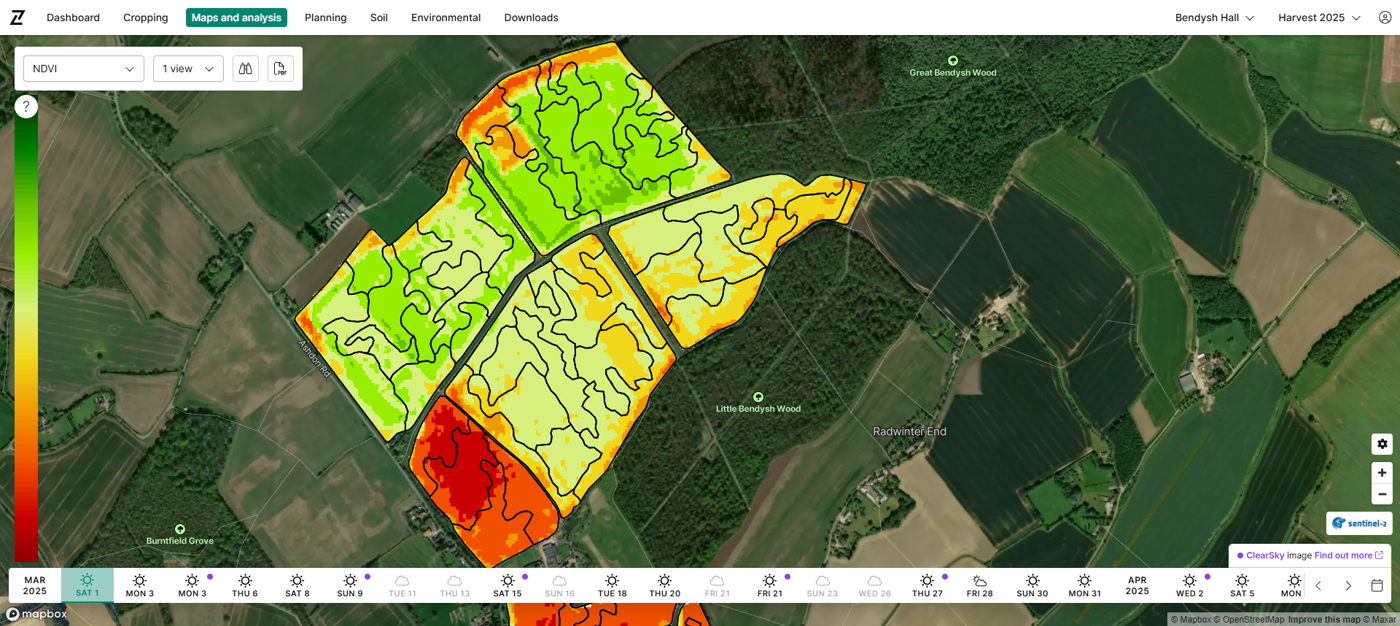
The most common satellite imagery used in agriculture is NDVI (Normalised Difference Vegetation Index).
NDVI works by measuring how plants interact with light. Healthy vegetation absorbs red light for photosynthesis and reflects near-infrared light. By comparing these wavelengths, NDVI provides an indication of crop greenness and biomass.
Jonathan Trotter, Technology Trials Manager at Agrii, explains that NDVI is best thought of as a relative greenness index rather than a direct plant health measurement.
“NDVI shows changes in crop greenness over time. Those changes can then be related to crop performance or potential stress.”
One reason NDVI is widely used is that it operates on a fixed scale between -1 and 1, making it easy to compare images across seasons.
Ben Foster, RHIZA Product Manager, says this consistency makes NDVI particularly valuable early in the season.
“NDVI images taken in different years can be compared directly. That makes it useful for assessing establishment and early crop growth.”
Because of this, NDVI imagery is commonly used when developing early spring variable rate nitrogen strategies.
Why ground truthing satellite imagery still matters
Satellite data is powerful, but it always needs context. Field knowledge remains essential when interpreting NDVI values.
“An NDVI score of 0.58 in a wheat crop doesn’t automatically tell you if the crop is performing well.”
Another challenge is distinguishing between crop biomass and weed biomass. A good example came from Agrii’s Scottish Digital Technology Farm, where NDVI imagery showed areas of apparently strong growth.
Drone imagery using Skippy Scout was used to verify the data. Skippy Scout calculates Green Area Index (GAI) and uses artificial intelligence to identify weed species within the crop canopy. By removing weeds from the calculation it provides a more accurate measurement of crop biomass.
In this case, the darker NDVI zones were partly caused by annual meadow grass rather than the crop itself. Ground truthing allowed the variable rate strategy to be adjusted accordingly.
“By combining NDVI with drone imagery, we can improve the resolution of remote sensing from roughly 5–20 m² down to centimetre-level data.”
When NDVI stops working well
NDVI performs best during early to mid-season crop development. Once crops reach a full canopy, the index becomes less reliable because the signal saturates.
At this stage agronomists usually move to NDRE (Normalised Difference Red Edge Index). NDRE uses light wavelengths from the red-edge spectrum, allowing it to penetrate dense canopies more effectively. This makes it particularly useful for assessing nitrogen status and chlorophyll levels later in the season.
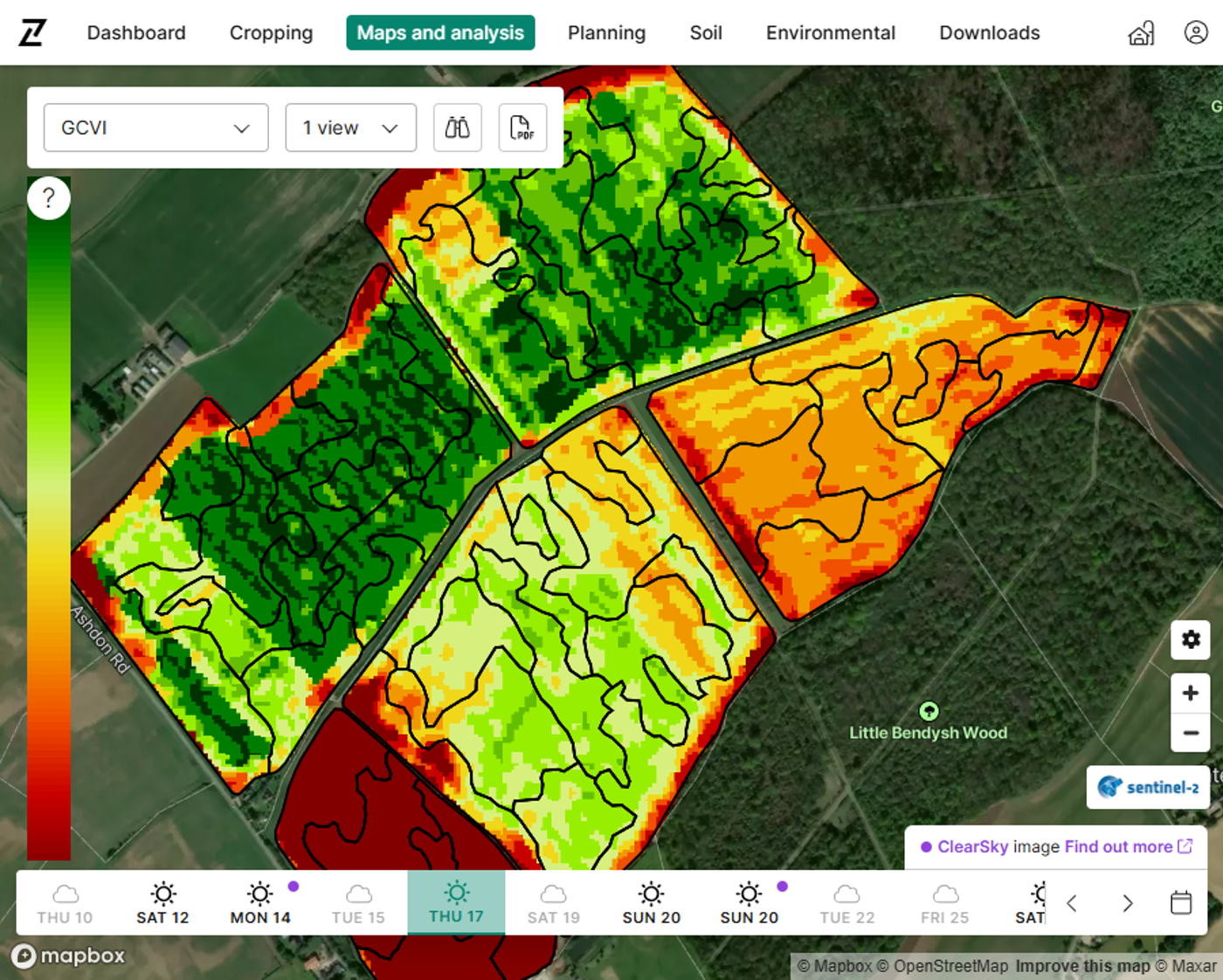
Another useful metric is GCVI (Green Chlorophyll Vegetation Index), which is available within Agrii’s Contour digital farming platform.
GCVI measures reflectance in the green spectrum rather than red. It is highly responsive to variations in chlorophyll levels and crop greenness. Unlike NDVI, GCVI uses a relative scale that changes as the image changes throughout the season.
“A GCVI image might show a poor part of the field, but it is always relative to the rest of the crop.”
The challenge of cloud cover in UK farming
One limitation of most satellite imagery is the need for a clear view of the crop canopy. In the UK, cloud cover can restrict the availability of usable images for extended periods.
During unsettled weather it can sometimes take several weeks or even months to obtain a new satellite image. Many platforms estimate crop development by modelling changes based on the most recent image available.
Agrii’s Contour platform approaches this differently by incorporating ClearSky radar imagery.
Radar satellites send microwave signals towards the crop canopy. The returning signal provides information about crop structure and biomass and works regardless of cloud cover or time of day. This data can be modelled within Contour to produce images comparable to NDVI maps, helping maintain reliable monitoring even during poor weather conditions.
What about hyperspectral satellite imagery?
Hyperspectral satellite imagery captures a much wider range of wavelengths than traditional satellite sensors, providing very detailed plant reflectance data. In theory, this allows more precise analysis of plant health.
However, hyperspectral imagery remains limited by cloud cover and the number of available satellites is still relatively small. Data availability can therefore be inconsistent. Without ground verification and soil context, hyperspectral data may not currently offer significant practical advantages over the imagery already available through platforms like Contour.
Satellite imagery works best as part of integrated crop monitoring
Satellite imagery is a powerful monitoring tool, but it works best when combined with agronomic knowledge and on-farm observation. Each type of imagery has strengths at different stages of the crop cycle. Understanding how these tools complement one another helps you turn imagery into practical field decisions.
The different types of satellite imagery at a glance
| Index | Data type | Best for | Why |
|---|---|---|---|
| NDVI (Normalised Difference Vegetation Index) | Red (620 - 670 nm) + NIR (841 - 876 nm) | Early to mid-season crop vigour | Shows biomass and canopy greenness but saturates in dense canopies |
| NDRE (Normalised Difference Red Edge Index) | Red-edge (705–750 nm) + NIR (780 - 850+ nm) | Mid to late season nitrogen status | Red-edge wavelengths penetrate dense canopies and highlight chlorophyll levels |
| GCVI (Green Chlorophyll Vegetation Index) |
Green (540 - 570 nm) + NIR (780–900 nm) | Biomass and nitrogen status | Tracks chlorophyll concentration and canopy development across the season |
| SAR (Synthetic Aperture Radar) e.g. ClearSky |
Microwave radar | All-weather crop monitoring | Penetrates cloud cover and operates day or night |
| RGB imagery | Visible spectrum (400 - 700 nm) | Visual crop inspection | High-resolution images but limited physiological insight |
If you want to explore how satellite imagery and ground truthing could support decisions on your farm, speak to your Agrii agronomist.
Join Our Community

Agrii X
We love engaging with clients and partners. Give us a follow and let's share stories for the community.

Agrii Instagram
A picture paints a thousand words. Follow us on Instagram to see what we are up to.

Agrii Facebook
Follow us on the worlds biggest social media site for the latest news and events straight to your feed.

Agrii LinkedIn
If you are all about the business, connect with us on LinkedIn to build your network
Stay In Touch

Journal Sign-Up
Receive email updates on topical news and information from around Agrii and UK Farming.

Listen To Our Podcasts
Listen to the Tramlines Podcast. Fortnightly chat about agriculture and trials with your host Tony Smith.

Agrii Insights
Read essential agri intelligence for profitable farming.

Find an Event
Join us for our upcoming events and tours.