


Farmers are increasingly being asked to provide for pollinators.
Here we provide some basic facts that will improve both your knowledge and understanding of bees and their vital role as pollinators upon which much of the world’s food depends.
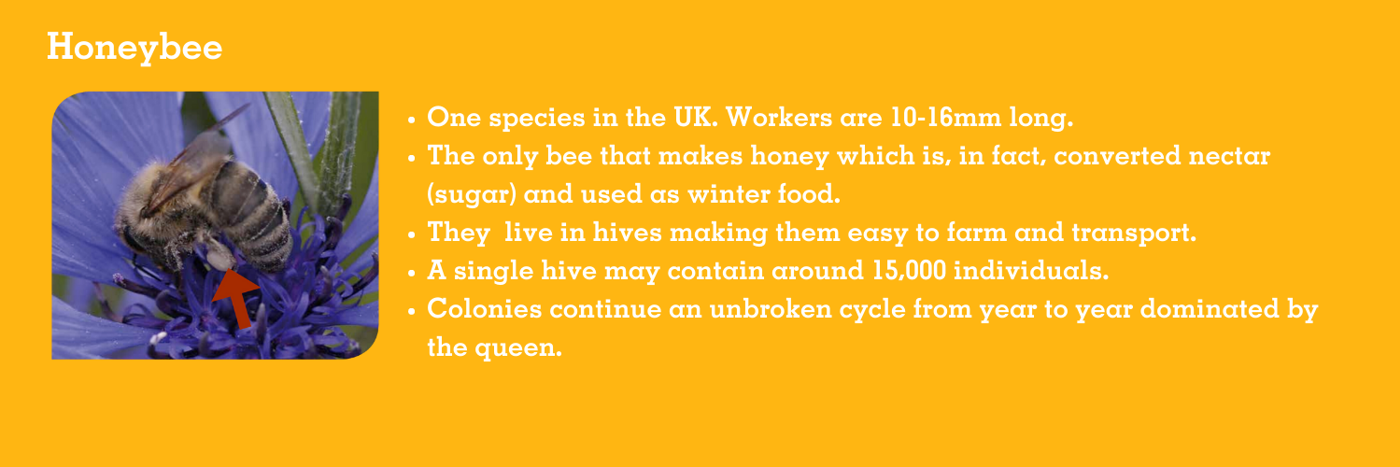
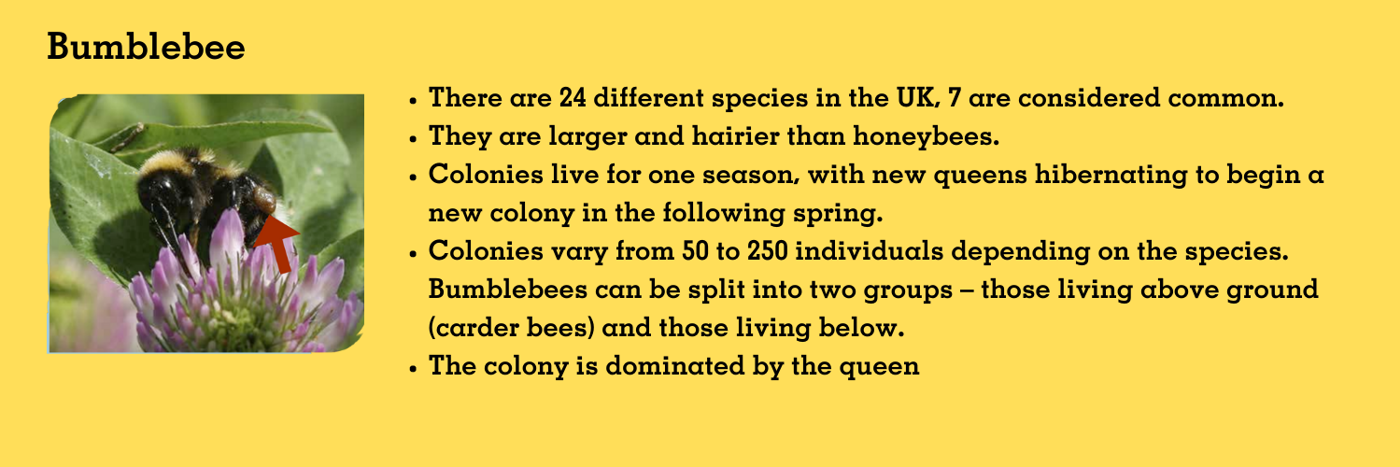
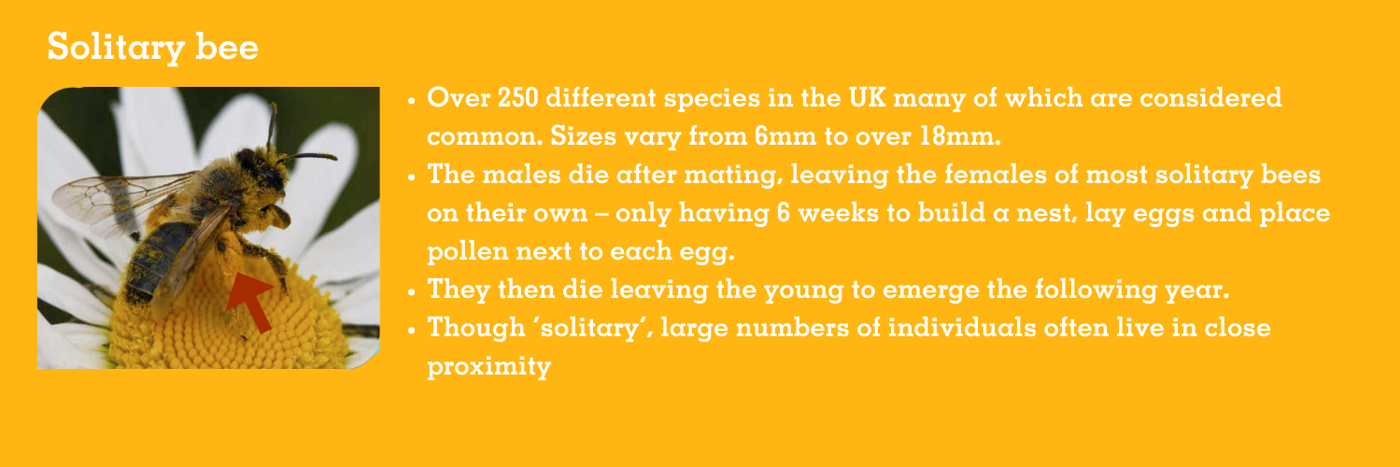
How do bees carry pollen?
When it comes to pollination this is a key factor.
The red arrows on the images above point to balls of wet pollen on honey and bumble but dry pollen on the solitary bee.
It is estimated that wet pollen is less than 20% viable for pollination purposes while dry may be around 80% viable.
When are bees active?
Depending on the species and the weather, bees are active from mid March to September.
What flower should I plant for bees?
Plant as many different shapes, colours and sizes as reasonably possible. This is because bees have a variety of tongue lengths and shapes.
Long-tongued bees such as Bombus hortorum (small garden bumblebee) has a tongue that is three quarters its body length so may be 15mm long, while some of the small solitaries Andrena minutuloides have a very small tongue of about 1mm.
What is pollen?
Pollen is produced on the anthers (male flower organs) and is essentially protein used to build up the queen and feed the developing young.
What is nectar?
Nectar is essentially sugar and provides energy – flying fuel.
When should flowers be available?
Ideally March to September. It is difficult to buy flowers for early season (March to May) flowering, so bees are reliant on ‘wild ‘species such as Dandelion, Wintercress, Cowslip and Primrose or tree species such as Hawthorn, Goat Willow, Blackthorn and Field Maple.
Mid and late season (June to September) flowers can be purchased as a variety of commercially available mixes.

Stay on top of schemes, compliance and new income opportunities
Environmental policy is moving quickly. Scheme detail shifts, new options come forward, and requirements change through the season. Keeping up can be time-consuming, and it’s easy to miss something important.
Our Environmental Services newsletter is there to keep things clear and relevant to your farm.
You’ll receive straightforward updates on scheme changes, what actions are worth considering, and where there may be opportunities to bring in additional income. We also highlight the compliance points that matter, so you can plan ahead and avoid issues later on.
The focus is practical. What’s working, what to watch, and what it means for your own rotation and business.
What you’ll get
- Timely updates on SFI and other environmental schemes
- Practical guidance on making options work on farm
- Insight into income opportunities and how they can fit together
- Clear reminders around compliance and key deadlines
- Advice shaped by what’s being seen across farms and applications
Join Our Community

Agrii X
We love engaging with clients and partners. Give us a follow and let's share stories for the community.

Agrii Instagram
A picture paints a thousand words. Follow us on Instagram to see what we are up to.

Agrii Facebook
Follow us on the worlds biggest social media site for the latest news and events straight to your feed.

Agrii LinkedIn
If you are all about the business, connect with us on LinkedIn to build your network
Stay In Touch

Journal Sign-Up
Receive email updates on topical news and information from around Agrii and UK Farming.

Listen To Our Podcasts
Listen to the Tramlines Podcast. Fortnightly chat about agriculture and trials with your host Tony Smith.

Agrii Insights
Read essential agri intelligence for profitable farming.

Find an Event
Join us for our upcoming events and tours.
Featured News

News - 02/10/26
Micronutrient boost to OSR canopies may unlock spring nitrogen savings
News - 25/09/26
Hybrid rye delivers strong yields through dry season
News - 15/09/26
Botrytis risk builds ahead of grape harvest
News - 14/09/26
Keep late blight protection in place as rain returns
News - 09/09/26
Post-Heatwave Nutrition Strategies for Stronger Autumn Crop Establishment